(Speech delivered as Chief Guest of the Sri Lanka Marketing Institute during the 2010 Effie Awards held in Colombo, Sri Lanka)
I bring you greetings from the Philippines and from my association the Philippine Marketing Association (PMA).
When I read the invitation of SLIM President Rohan Somawansa, I did not hesitate to accept. I cleared up my schedule and went on to book the flight. Earlier this year, I invited all national marketing association members of the Asia Marketing Federation to attend the PMA National Marketing Conference (NMC). Sri Lanka Institute of Marketing (SLIM), through Rohan, was the first to accept. Rohan even volunteered to bring along a super speaker from Sri Lanka. And he did.
SLIM has always responded to our invitation to attend our national and world conferences. I would like to think that the PMA should do no less and respond to SLIM’s invitation. SLIM and the PMA have developed this unwritten partnership based on mutual interests and objective. SLIM and PMA members have also developed close ties and friendship. You can consider SLIM and PMA as one tiny block in the Asian Marketing Federation. I believe that our countries share similar problems and circumstances.
Moreover, SLIM and the PMA have similar mission and vision. Founded in 1970 and subsequently incorporated by an Act of Parliament in 1980, SLIM has been promoting marketing and elevating the status of marketing in Sri Lanka. The PMA’s mission is to develop and promote Marketing as a science and profession guided by the universal principles of ethics, corporate citizenship and social responsibility and to serve as a policy making and recommendatory arm of the government on Marketing related issues
SLIM’s vision is to establish marketing as the driving force, which enhances business and national value. PMA’s vision is to create awareness on the power of marketing in business, industry and the academe, both here and abroad. The PMA's theme this year is “Marketing as Growth Accelerator.” Marketing as a growth accelerator advances the idea that the discipline of marketing is a superior approach towards sustainable corporate growth and profitability. The frameworks that are found in marketing are essentially the prescription for sustainable growth and profitability.
SLIM and the PMA are active members of the Asia Marketing Federation, and, by virtue of the affiliation, are both associated with the World Marketing Association, and UN Global Compact.
As active promoters of the art and science of marketing and as practitioners, SLIM and the PMA subscribe to the basic tenets of best practices in marketing and change management through customer and market understanding.
We just attended the Board of Management meeting of the AMF on November 4 and 5 in Tokyo. In that meeting, we reaffirmed the growing importance of the Asian region in the global economy. Two of the top three global economies come from our region. It is also expected that very soon, China will become the global leader and the biggest economy in the world. It will be this region and many countries in this region where economic growth will be sustained.
In Tokyo, SLIM and PMA attended a global conference organized by the AMF and Japan Marketing Association. Two distinguished scholars and writers presented their thesis about the role of marketing in development and the future of marketing as a driver for growth. Professor Hyun-Chul Kim of Seoul University outlined the accomplishments of Korea and what it did to rise above the difficulties brought about by the global crisis and become a world competitor. Hermawan Kartajaya, considered as one of the top 50 marketing gurus in the world, presented what marketing should and will be in the future and the importance of change in driving economic growth.
From these discussions, I realized that the changes driving economic growth in Asia are essentially market-driven and rooted on the successful applications of the latest principles of marketing. On the other hand, the principles that are dictating the type of marketing strategies are evolving. I consider Marketing's dynamism and its propensity to change and evolve as the elements that make marketing an important driver of corporate growth and profitability.
Such significance can only surface by recognizing the role of marketing in driving institutional growth and success. The Effie Awards, a global awards scheme which selects the most effective advertising campaigns that have excelled at the national and international levels, provide such recognition. Through these Awards, SLIM promotes best practices in the advertising industry. It is also through these awards that SLIM is able to provide industry and government with guidelines for driving growth. This is consistent with SLIM’s mission of being an active leader in the nation’s efforts towards economic prosperity and SLIM’s vision of establishing marketing as the driving force to create business and national value.
In that session, I also realized that the world does not stand still. In the 1960s and 1970s, South Korea was at the lower end of the list of countries in terms of economic development. Indonesia was very parochial and had very few executives that could be considered as global thought leaders. But lo and behold, Japanese top executives attended the session and listened to a Korean professor and an Indonesian marketing consultant.
I congratulate Sri Lanka Institute of Marketing (SLIM) for carrying the torch of excellence in marketing through the Effie Awards. These awards are very significant not only to the marketing profession in Sri Lanka but also to the members of the Asian Marketing Federation (AMF) of which SLIM and PMA are members.
Let me also congratulate the awardees, the epitome of excellence and considered the best of the best and the most effective MARCOM Campaigns in 2010.
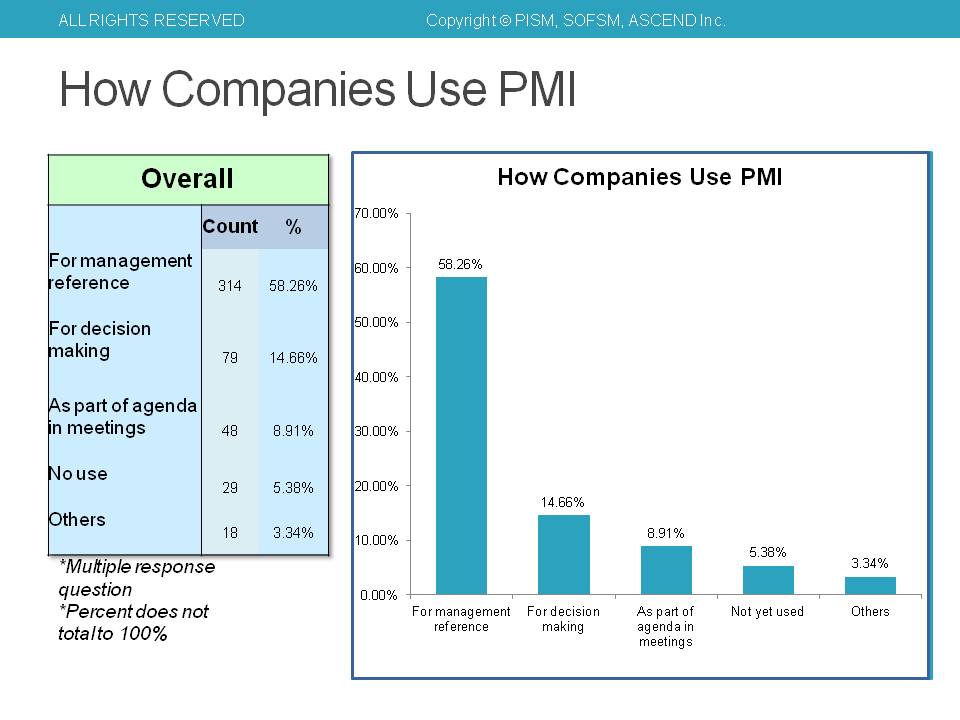
 Together, these three economic surveys provide policy decision makers in government and industry with a significant foresight about the economy month on month. PMI users were asked to evaluate how this economic indicator is able to help the company. Significantly, 58% of PMI subscribers use PMI as a management reference while 15% use this indicator for decision making.
 PMI Manufacturing, as a leading economic indicator, has been able to sufficiently plot the direction of the economy -- whether it expanded or contracted -- each current month as compared to the previous month. This reading is reported to readers during the first week of the succeeding month -- three months ahead of the GDP.
 For more information on PMI Philippines or if you have questions, send an email to nick_fontanilla@ascendph.com.