Monday, August 26, 2013

creating a difference...through PMI

This management team of Metrics Asia is creating a difference. Sacrificing for country, industry and the profession to provide critical information about conditions in the Philippine economy month after month. Taking over the task willingly at the time needed to keep the Purchasing Managers' Index going. Modern day heroes.


So does this PMI operations team. Facing all challenges. Determined to make a difference. To serve. To do something meaningful. For country and the supply chain profession.


And the associations that made it possible -- Foundation of the Society of Fellows in Supply Management (SOFSM) and the Philippine Institute for Supply Management (PISM).

Together, proudly and happily, they commit to keep the PMI going every month. Together, they envision to expand to cover ASEAN and Asia-Pacific. Cheers to a great team.

Watch out for PMI Philippines August 2013. For more information, email to info@imetricsasia.com.

Tuesday, August 20, 2013

anticipatory marketing

There are two components of Anticipatory Marketing (AM). Consumer choice and consumer experience.

Consumer choice is a consumer's mental image of a product or service. The mental image is what the consumer prefers or desires. Christensen, Olson and Ross refer to it as a consumer's self-referrent image of a product. A choice that emerges from a combination of knowledge, experience and suggestive information. It is most often what a consumer buys. Although not all the time. There are multiple gaps between a consumer's choice and a consumer's decision to buy.

For example, a time gap exists. Benjamin Libet's theory on free will recognizes a time lag between conscious purchase and free will. This time lag affects a consumer's ability to respond in real time. Which explains in part, or which appears to lead to, impulse buying. Shariff and Peterson of University of Toronto explain this perfectly well in their article on anticipatory consciousness. There are other gaps. Resource gap. Convenience gap. Influence gap. Which are all self explanatory. AM fully recognizes the consumer's self referent image and the realities that allow or prevent this image to materialize.

This position is significant in the formulation of an AM agenda. AM understands that consumer choice, to a manageable extent, is predictable. AM contends that by understanding and measuring the conscious choice, both in the context of what is desired and realities of consumption, a marketer may be able to anticipate the actions of a consumer. How?

Consumer experience is the sum total of a consumer's conscious choice and conditions that dominate this choice. This is measured by actual transactions which may be available in documented transactions or defined in statistical surveys. In its absence, actual transaction may be substituted by primary data drawn from a well-designed statistical survey. AM requires an investigation of consumer choice and free will. Results strengthens findings derivable from actual transactions.

The charts below shows an execution framework for AM presented in a hierarchical sequence (chart 1).
 
Chart 1: AM Execution Framework 
    
Is AM anticipation marketing. No, it is not. Although AM looks at anticipation marketing as an important influencer in consumer choice. It may have a greater influence in a consumer's free will. Anticipation marketing, as defined by Baron, Hickey and Merrel,  is identifying, exploring and understanding an interesting consumer response phenomena -- collective irrationality. It is a strategy that drives interest in a product in the absence of above the line and below the line advertising.

How is AM different from predictive analytics? Predictive analytics makes use of transactional data to generate a predictive model. Sometimes exclusively. AM borrows from various disciplines, as shown in the chart below, and formulates a consumer model that combines consumer choice, free will and consumer experience.

               Chart 2: Components of AM      

For comments, email Nick Fontanilla to abfontanilla@yahoo.com or nick.fontanilla@gmail.com. For inquiries on Anticipation Marketing and how a company may be able to make use of this tool, email to info@imetricsasia.com.

Bibliography
1. Glenn L. Christensen, Jerry C. Olson, William T. Ross, "Why Consumption Vision? Understating Consumer Value in Anticipatory Consumption Imaging," Advances in Consumer Research Volume 31, © 2004 (www.acrwebsite.org/volumes/v31/acr_vol31_65.pdf) 
2. Azim F. Shariff and Jordan B. Peterson, "Anticipatory consciousness, Libet’s veto and
a close-enough theory of free will," University of Toronto (http://sharifflab.com/wp-content/uploads/2012/03/Shariff-Peterson-2005.pdf)
3. Ellen Baron, Kristin Hickey and Paul Merrell, "Anticipation Marketing: Understanding buzz for Generation Now, Esomar, 2008.

Thursday, August 15, 2013

PMI on its 61st Run

Amazing Feat: PMI on its 61st run

The Foundation for the Society of Fellows (SOFSM), advocacy arm of the Philippine Institute for Supply Management (PISM), has completed 61 months of PMI Philippines in July 2013. Truly, an amazing feat. SOFSM and PISM have accomplished two important goals. First, providing government and industry with a leading economic indicator now used by Bangko Sentral ng Pilipinas (BSP). Second, enhancing the image of the supply chain profession making supply chain an important component of economic growth and development. This feat was made possible with the support of BSP, The Asia-Pacific Centre for Research (Acre), Inc. and AB Fontanilla Consulting Services.    


A Project of SOFSM

The Purchasing Managers Index Philippines is a project of SOFSM in cooperation with PISM. PMI Philippines was designed to complement and to be consistent with PMI surveys in other countries. This index started in North America in 1931. There are now 32 PMI countries including the Philippines.

                                                
Marketing Arm

PMI Philippines is  exclusively distributed by I-Metrics Asia-Pacific Corporation (IMetrics Asia). Metrics Asia is an e-commerce and consulting company.  Metrics Asia's product portfolio includes PMI Philippines, PMI ASEAN, PMI Asia, E-Commerce Index Philippines (ECIP), Product Demand Index Manufacturing (PDIM), and E-Commerce Maturity Model (ECMM). Metrics Asia also provides training in ecommerce analytics, predictive analytics, and performance management. 


I-Metrics Asia recently participate in the National Retail Conference and Stores Asia Expo 2013. It has lined up other events to bring PMI Philippines to more areas and practitioners.


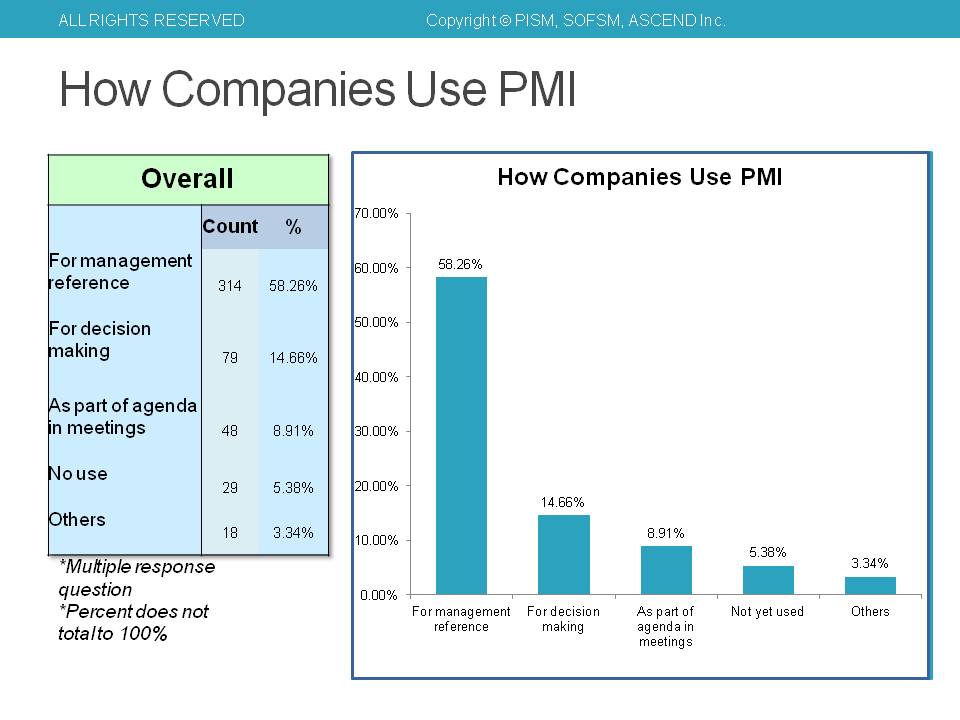
PMI Philippines is used by users and subscribers primarily for management reference and decision making.

For more information on PMI, contact info@imetricsasia.com.

ANTICIPATORY MARKETING

Learn. Apply. Lead.
A Free Webinar on an Emerging Principle in Marketing.
August 20, 2013
3:00 to 4:00 p.m.

Sunday, April 1, 2012

PMI on its 44th reading

In April 2007, we conducted the pilot test for the Purchasing Manager's Index (PMI) Philippines. Fifteen months after (July 2008), PMI Philippines made its foundational run featuring PMI Manufacturing. Since its initial run, the PMI has been conducted every month without fail.

Now on its 44th reading, PMI Philippines has become the earliest leading economic indicator available to planners and decision makers. It provides policy decision makers with a directional tool based on actual conditions in industry. Two other PMI surveys have been activated -- PMI Retail/wholesales which is now on its 35th run, and PMI Services which is now on its 17th run.

Together, these three economic surveys provide policy decision makers in government and industry with a significant foresight about the economy month on month. PMI users were asked to evaluate how this economic indicator is able to help the company. Significantly, 58% of PMI subscribers use PMI as a management reference while 15% use this indicator for decision making.

PMI Manufacturing, as a leading economic indicator, has been able to sufficiently plot the direction of the economy -- whether it expanded or contracted -- each current month as compared to the previous month. This reading is reported to readers during the first week of the succeeding month -- three months ahead of the GDP.

Where PMI is extensively used (such as North America and Europe), PMI is used as a leading economic indicator to predict way in advance the GDP. It confirms if the economy expanded, a confirmation that gives decision makers a persuasive guideline for action. It is most useful, however, when it gives readers a bold reading of when the economy is contracting. The PMI was able to foresee the economic contraction in the last quarter of 2008.

For more information on PMI Philippines or if you have questions, send an email to nick_fontanilla@ascendph.com.

Saturday, March 24, 2012

the dragon comes to life

The Dragon sleeps....


Then it comes to life.


Triton Dragon Boat Team puts its act together.


For the MBC dragon boat competition on March 25, 2012.


A chance to compete. Make friends.
A time to connect with nature.
Using raw power.
And a discipline to work together.


Wednesday, March 9, 2011

I Touched Manila Bay

I touched the untouchable -- Manila Bay. As a rower in the Dragon Boat Regatta 2011 held on Sunday, 6 March 2011. Organized by the Philippine Dragon Boat Federation, over 100 rowers and thousands of viewers were there.

This was a chance for many to see how beautiful Manila Bay is and how beautiful it can be if restored to its old glory. I row to touch it. To see it. And, in my own small way, send a message. That is, make it touchable again.